





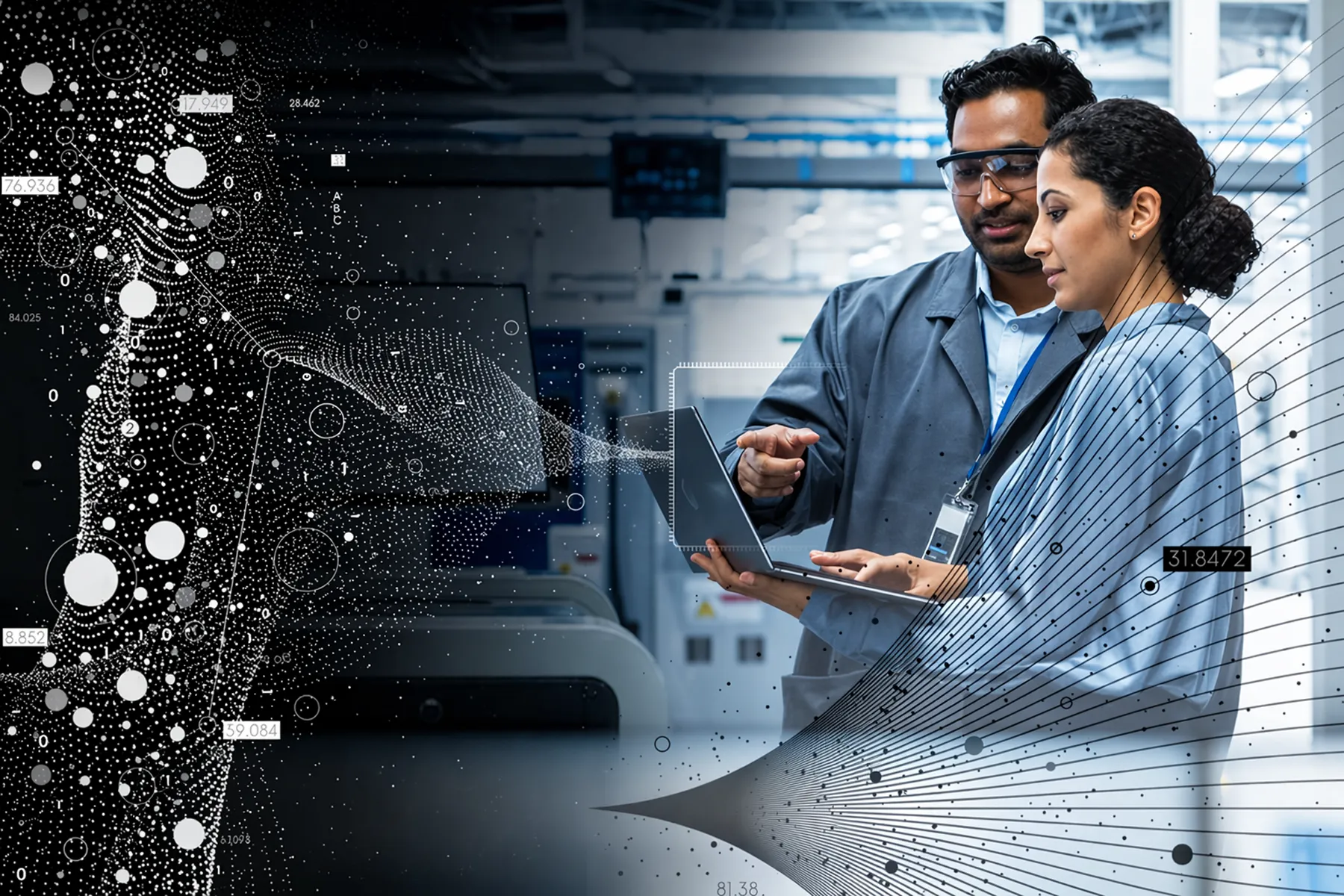
In recent years, the pressure on manufacturers has been steadily increasing: higher volumes, stricter tolerances, and ever-higher quality requirements. Against this backdrop, machine vision systems based on artificial intelligence (AI) have quickly evolved from a “novel” technology to an essential one in manufacturing.
A study conducted among hundreds of manufacturers, integrators, and OEMs clearly points the way: AI is no longer just about performance, but about striking a balance between accuracy and ease of use.
The adoption of AI is no longer a question, but a reality
Datele arată că 57% dintre companii folosesc deja sisteme de machine vision bazate pe AI, iar alte 30% intenționează să le implementeze în curând. :contentReference[oaicite:1]{index=1}
Adoption is already widespread in industries such as logistics, automotive, and electronics, where speed and accuracy are critical. In contrast, sectors such as FMCG and healthcare are more cautious, even though the need is there.
One thing is clear: companies that settle for “good enough” solutions risk losing their competitive edge.
What really matters when choosing a modern vision system
At first, most companies focus on a single criterion: accuracy. And this is understandable, given that industrial applications often require accuracy of over 99%.
But operational experience changes priorities. After implementation, users begin to appreciate more:
- ease of implementation
- speed of development and adaptation
- simplified maintenance
- scaling across multiple lines or locations
In short, accuracy is what sells the system, but simplicity is what makes it profitable in the long run.
Why AI Outperforms Traditional Systems
- Detecting defects that traditional algorithms miss
AI systems can identify subtle defects: micro-scratches, subtle color variations, or barely visible contaminants. These are real problems in manufacturing, but they are often impossible to capture using fixed rules. - Reducing false alarms
The AI understands the context. It can distinguish between an acceptable variation and a real defect, significantly reducing the number of unnecessary rejections. - Adaptability to real-world variations
Unlike traditional systems, AI does not require perfect conditions. It learns acceptable variations and identifies only relevant deviations. This is critical in high-variability production environments.
Real-world efficiency: where the AI runs matters
An important decision is where the intelligence runs:
- Edge (on-device) – fast, reliable, and low-latency
- Industrial PC – powerful, but more complex
- Cloud – scalable, but unsuitable for real-time applications
The trend is clear: edge AI is becoming the industry standard. Why?
- instant processing
- minimum latency
- low operating costs
- reliable operation in harsh industrial environments
Simplicity: the underrated advantage
One of the most interesting findings of the study is that perceptions of AI change after use. Modern Cognex systems offer:
- automatic configuration from images
- training with very little data
- intuitive interfaces, no programming required
- automatic performance monitoring
- quick adaptation to product changes
In practice, this means you no longer need dedicated specialists for every adjustment. Production engineers can manage the system directly.
Scalability: from pilot to full implementation
AI is changing the way projects are scaled:
- implement on a line
- validate the results
- quickly scale up to other locations
Modern architecture enables development in the cloud and production deployment at the edge, combining flexibility with performance. More importantly, AI makes applications possible that were previously not economically viable.
What does this mean for companies?
The conclusion is simple, but it’s worth stating plainly:
- Accuracy is no longer enough
- Simplicity becomes a decisive factor
- Operational experience matters more than the initial specifications
Companies that choose comprehensive solutions are most likely to achieve tangible results.
Looking ahead
AI-based machine vision is no longer an experimental technology; it is already widely adopted and continues to evolve. The direction is clear: you no longer have to choose between performance and ease of use. Modern vision systems offer both.
If you view the investment solely in terms of reducing waste, you’re missing out on a significant part of its value. The real benefits lie in flexibility, rapid scalability, and operational efficiency.
Want to see how these technologies work in practice?
Discover the Cognex solutions available in our portfolio:
See Cognex products