
Industrial automation is evolving rapidly. Companies need robots that are not only more powerful but also easier to integrate, program, and adapt to new applications.
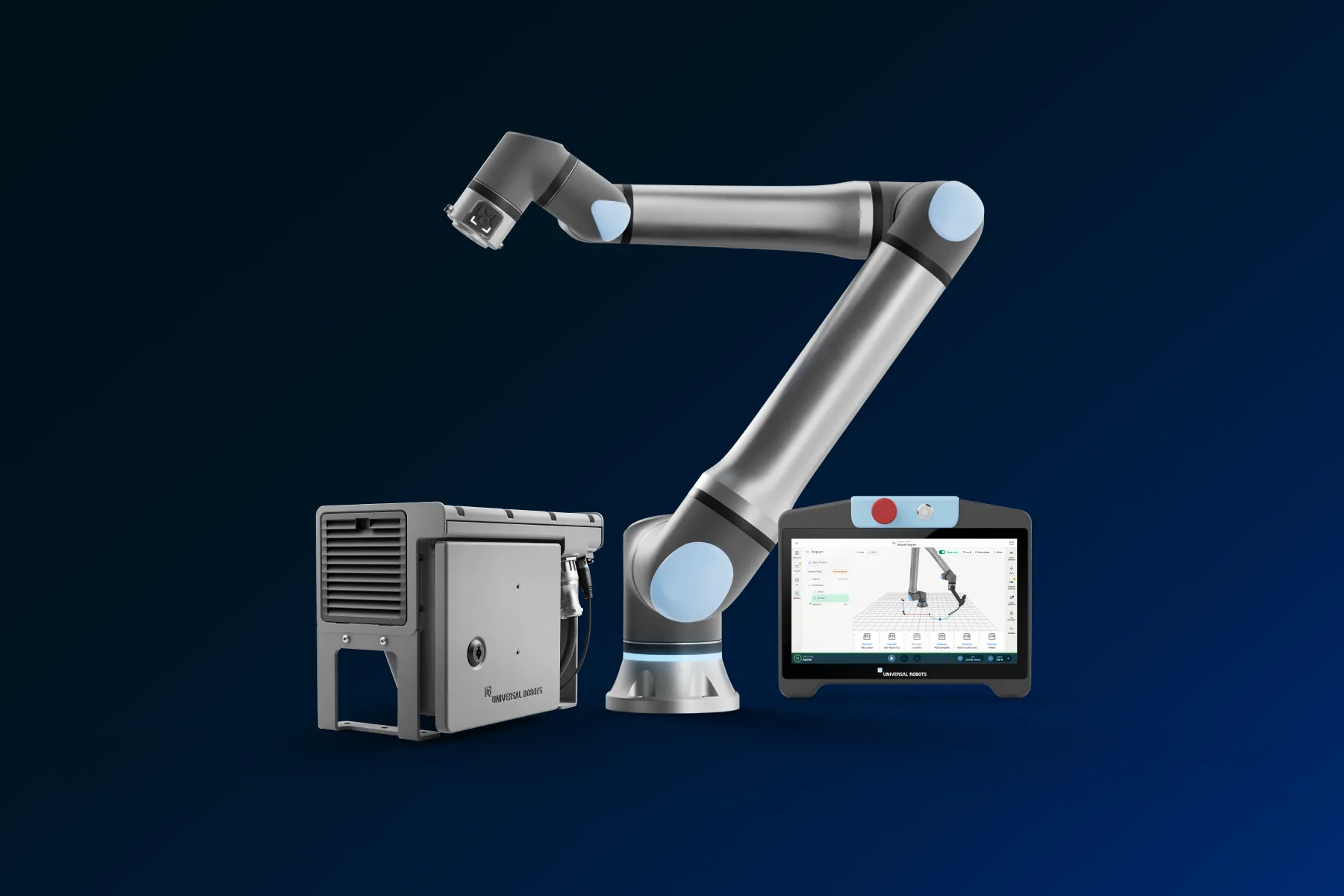
In this context, Universal Robots is launching Gen 7, a unified platform that combines the new g-Series collaborative robots with a more compact controller, modern operating interfaces, and software designed for artificial intelligence-based applications.
The Gen 7 is built on the experience Universal Robots has gained over more than 20 years and through the deployment of more than 100,000 robots.
Gen 7 is more than just a new robot
The Gen 7 platform brings together the following in a single ecosystem:
- g-Series collaborative robots
- the CB7 Core controller
- TP7 Core Programming Console
- SP7 Smart Panel
- PolyScope X software platform
All components are designed to work together. The goal is to reduce integration complexity, the number of external components, and the amount of wiring required in a robotic cell.
In short, Gen 7 aims to facilitate the transition from concept and testing to a fully functional industrial application.
Three robots for different needs
The new g-Series family includes three models:
- UR10g-1750 – 8 kg payload, expandable to 10 kg, and a reach of 1,750 mm.
- UR17g-1300 – 15 kg payload, expandable to 17.5 kg, and a reach of 1,300 mm.
- UR18g-950 – 18 kg payload and 950 mm reach.
The UR10g and UR17g models can reach a TCP speed of up to 5 m/s, while the UR18g reaches up to 4 m/s.
This product line allows you to choose a robot based on your application's priorities: a large working radius, a balance between payload and accessibility, or the ability to handle heavier loads in a compact space.
Faster integration with fewer cables
One of the most significant changes is the integration of the connections directly into the robot's flange.
The g-Series offers:
- 24- or 48-volt power supply
- 1 Gb Ethernet connection
- digital inputs and outputs
- analog input
- RS-485 communication
Cameras, sensors, and equipment mounted at the end of the arm can be connected more easily, without external cables running between the flange and the controller.
For integrators and users, this can mean faster installation, fewer auxiliary components, and a robotic cell that is easier to maintain.
Industrial-grade construction
The new robots use a closed-joint architecture and feature IP65 protection against dust and water.
An LED light ring located at the base of the robot provides a visual indication of the cell's status. Operators can more easily check whether the system is running, is shut down, or requires attention.
By reducing the number of exposed components and simplifying the infrastructure, Gen 7 is designed for reliable operation in demanding industrial applications.
Direct control from the robot
The new SP7 Smart Panel brings frequently used controls directly into the application.
The control panel is mounted on the robot and allows for intuitive two-handed operation. It includes a two-stage Freedrive button and three buttons that can be configured using PolyScope X Smart Skills.
The SP7 can be detached when the robot is operating in environments such as welding or machining, where the panel must be protected from sparks, chips, or debris.
This approach reduces the need for repeated trips between the robot and the main console and can simplify application setup.
CB7 Core and TP7 Core simplify operation
The CB7 Core controller offers more processing power and expanded connectivity, while taking up 20% less space.
It includes:
- three 1 Gb Ethernet ports
- 16 configurable digital inputs or outputs
- 24 Vdc, 4 A power supply
- IP54-rated enclosure
- cables that can be replaced in the field
The TP7 Core console complements the system with a responsive touchscreen and a virtual joystick. The interface is designed to simplify programming, configuration, and day-to-day operation.
Ready for Artificial Intelligence
Gen 7 works with PolyScope X, the software platform that connects hardware components, robot programming, and applications within the ecosystem.
Open APIs and the SDK enable the development and native execution of artificial intelligence-based applications. Support for ROS 2 facilitates control via external processing systems and the integration of cameras or smart gripping devices.
The platform also allows for the separation of robotic cell data from the factory's IT and OT traffic, which is important for the secure expansion of automation.
Compatibility with the UR+ ecosystem
The Gen 7 is compatible with the UR+ ecosystem, which includes grippers, cameras, sensors, software, and complete, validated solutions for Universal Robots robots.
Companies can build on components that have already been tested together, reducing the time and risks associated with developing an application from scratch.
The new platform can be used for material handling, machine feeding, palletizing, welding, assembly, inspection, and quality control.
What Gen 7 Brings to Production
The platform's advantages can be summarized simply:
- faster integration
- fewer cables and external components
- Intuitive operation and programming
- modern industrial connectivity
- Compatibility with UR+ solutions
- support for AI-based applications
- the possibility of expanding into new processes
Gen 7 aims not only to improve the robot's performance, but also to simplify the entire automation process—from installation and programming to operation and expansion.
Discover the possibilities of Gen 7
Would you like to find out how the Universal Robots Gen 7 platform can be used in your application? Contact the Multitech team for consultation and to configure a solution tailored to your production process.